Blog, News
Professor Celestine Iwendi Delivers Two Keynotes on Responsible AI at International Conference in China
Nov
The Head of CIoTh calls for next-generation AI that drives trusted scientific discovery, and showcases the centre’s Smart Knee Coach research.
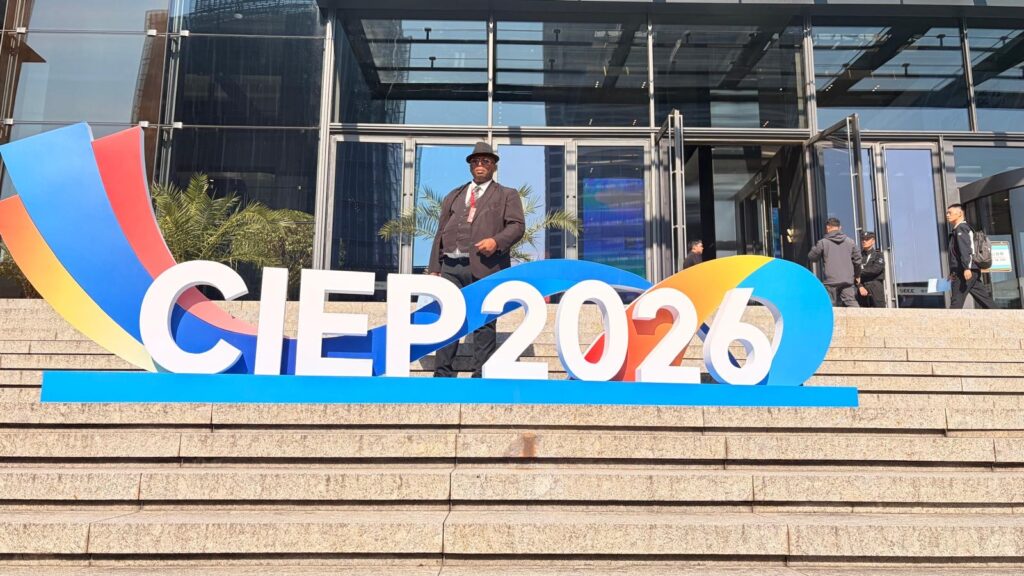
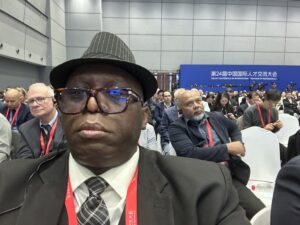
Professor Celestine Iwendi, Professor of Artificial Intelligence and Head of the Centre of Intelligence of Things (CIoTh) at the University of Greater Manchester, delivered two keynote presentations at the 24th Conference on International Exchange of Professionals (CIEP 2026) in China.
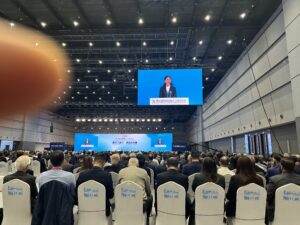
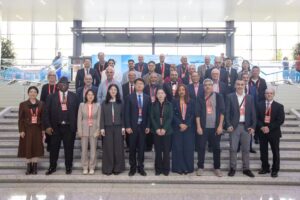
He spoke at the International Forum on Integrated Circuits, Intelligent Sensing and AI for Meteorological Applications. Nanjing University of Information Science and Technology (NUIST) hosted the forum on 14 November 2026. It brought together researchers working on AI, integrated circuits, intelligent sensing and emerging technologies.
AI beyond automation
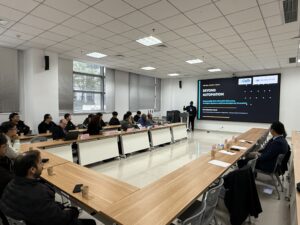
In his first keynote, “Beyond Automation: Responsible AI for Scientific Discovery, Intelligent Systems and Interdisciplinary Innovation,” Professor Iwendi argued that AI’s next phase should do more than speed up tasks people already do. It should help researchers reason, form testable hypotheses and produce reliable evidence across disciplines.
“The future of artificial intelligence is not simply about automating what humans already do,” he told delegates.
He covered machine learning, intelligent sensing, edge computing, federated learning, digital twins and explainable AI. Throughout, he stressed governance, transparency, privacy and human oversight. AI, he argued, should be judged by its reliability, reproducibility and value to society, not by computing power alone.

From sensing to trusted healthcare: the Smart Knee Coach
His second keynote, “From Intelligent Sensing to Scientific Discovery: Trusted AI-IoT Healthcare and the Smart Knee Coach Research Exemplar,” presented a CIoTh research concept for knee rehabilitation. The Smart Knee Coach combines motion sensors, intelligent algorithms and clinician-supervised feedback to assess the quality of patients’ movement. It addresses a long-standing gap: clinicians find it hard to monitor patients between appointments.
Professor Iwendi was clear that this is research in progress and needs rigorous clinical validation before any real-world medical use. That position reflects CIoTh’s commitment to trustworthy, evidence-led AI.
Building international partnerships
The visit also explored possible collaboration between NUIST and the University of Greater Manchester, in areas including:
- responsible medical AI
- intelligent sensing and advanced computing
- distributed and edge AI
- digital twins
Possible activities include joint research, postgraduate training, academic exchanges and joint publications, all subject to institutional agreements and research governance.
Professor Iwendi thanked NUIST President Professor Chen Haishan, Professor Fayu Wan and Professor Blaise Ravelo for their support in making the engagement possible. Dr Chika Judith Abolle-Okoyeagu, Associate Professor at Robert Gordon University, Aberdeen, also spoke at the forum, on closing the gap between STEM talent and industry demand in an AI-driven economy.
A message for Africa and the developing world
Professor Iwendi also highlighted AI’s potential to transform healthcare, agriculture, education, environmental management and digital infrastructure in developing countries. He urged greater investment in AI education, scientific infrastructure and postgraduate research, so that African researchers help shape AI rather than only consume it.
Closing his remarks, he said AI’s future will be shaped by connected researchers working together, not by institutions working alone.
